
Seamless vs Welded Pipe: What's the Difference? Which is Better?
Seamless vs welded steel pipe comparison — strength, pressure rating, cost, availability, and how to choose the right pipe for your application.
Seamless Steel Pipe
Solid — no weld seam, higher pressure rating
Welded Steel Pipe
Rolled & welded — cost-effective, wide size range
Overview
The choice between seamless and welded steel pipe is one of the most fundamental decisions in piping specification. Both have their strengths, weaknesses, and ideal applications.
Quick summary: Seamless pipe is stronger, can handle higher pressures, and is better for high-temperature and critical applications — but it’s more expensive. Welded pipe is cheaper, more readily available in large sizes, and perfectly adequate for most general-purpose applications.
Comparison Table
| Property | Seamless Pipe | Welded Pipe (ERW / LSAW / SSAW) |
|---|---|---|
| Manufacturing method | Pierced from a solid billet | Flat plate rolled and welded |
| Weld seam | None (seamless) | Longitudinal or spiral weld |
| Pressure rating | Higher (~20–30% higher than same-grade welded) | Lower (weld is the weak point) |
| Strength uniformity | Excellent — uniform in all directions | Slightly lower at weld seam |
| Available sizes (OD) | 1/2" – 24" (common), up to 36" max | 1/2" – 120"+ (virtually unlimited) |
| Wall thickness options | Wide range (Schedule 40 to XXS) | Limited range (thinner walls more common) |
| Dimensional tolerance | Tighter OD tolerance | Tighter wall thickness tolerance |
| Surface finish (internal) | Generally rougher | Smoother interior (ERW) |
| Cost per ton | Higher (~30–50% premium) | Lower |
| Availability | Good — but sizes limited | Excellent — all sizes readily available |
| Maximum length | Usually limited (6–12m random) | Long lengths possible (up to 18–24m) |
| Corrosion resistance | Same (same base material) | Same (same base material) — but weld area may be slightly different |
| Weldability | Good | Good (but welding near the seam requires care) |
| Ideal for high pressure | Excellent | Fair — Good (depends on grade and testing) |
| Ideal for high temperature | Excellent | Good |
| Suitable for structural use | Good (but overkill usually) | Excellent — best value |
Seamless Pipe — In Detail
Seamless pipe is manufactured by piercing a solid steel billet with a piercing plug to create a hollow tube. The pipe is then rolled and sized to the final dimensions. Because there’s no weld seam, the pipe has uniform strength around its entire circumference.
How Seamless Pipe is Made
- Heating: A solid cylindrical billet is heated to high temperature
- Piercing: A piercing mandrel pushes through the center, creating a hollow shell
- Rolling: The shell is rolled to reduce wall thickness and increase length
- Sizing: Final sizing to exact OD and wall thickness
- Heat treatment: Normalizing or quenching & tempering as required
- Testing & inspection: NDT, hydrostatic test, dimensional checks
Key Advantages of Seamless Pipe
- Higher pressure rating: No weld seam = no weak point
- Uniform properties: Consistent strength in all directions
- No weld inspection needed: No risk of weld defects
- Thicker wall options: Suitable for very high-pressure applications
- Better high-temperature performance: Uniform grain structure
- Widely accepted for critical service: Specified in most oil & gas, boiler, and high-pressure codes
Limitations of Seamless Pipe
- More expensive: Higher manufacturing cost
- Size limitations: Difficult and expensive to make large diameters
- Longer lead times: Less available in large or unusual sizes
- Rougher interior surface: Higher friction for fluid flow
- Dimensional variation: OD tolerance not as tight as welded
Common Applications of Seamless Pipe
- Oil & gas drilling and production (tubing, casing, line pipe)
- Boiler tubes and heat exchangers (high temp/pressure)
- Hydraulic and pneumatic systems
- High-pressure process piping
- Power generation (superheater tubes, reheater tubes)
- Automotive and aerospace tubing
- Mechanical and structural applications where stress is critical
Welded Pipe — In Detail
Welded pipe is made by rolling flat steel plate or coil into a cylindrical shape and welding the edges together. There are several types based on the welding method:
- ERW (Electric Resistance Welded): Most common for smaller sizes (1/2" – 24")
- LSAW (Longitudinal Submerged Arc Welded): For large-diameter, thick-walled pipe
- SSAW / HSAW (Spiral Submerged Arc Welded): For large diameter, long lengths
How Welded Pipe is Made (ERW Example)
- Uncoiling: Steel coil is fed into the mill
- Forming: Rollers form the strip into a tubular shape
- Welding: High-frequency current welds the edges together
- Bead removal: Internal and external weld beads are smoothed
- Sizing: Final sizing and straightening
- Testing: Non-destructive testing (ultrasonic, hydrostatic)
- Finishing: End facing, threading, or beveling
Key Advantages of Welded Pipe
- Lower cost: 30–50% cheaper than seamless pipe
- Wider size range: From very small to extremely large diameters
- Better surface finish: Smoother interior (especially ERW)
- More consistent wall thickness: ±5–10% vs ±12.5% for seamless
- Faster delivery: High-volume production = good availability
- Longer lengths: Up to 18–24 meters or even longer
Limitations of Welded Pipe
- Weld seam is the weak point: Pressure rating is lower than seamless
- Risk of weld defects: Requires careful quality control and testing
- Not always accepted for critical service: Some codes require seamless
- Weld area can be prone to corrosion: If not properly heat treated
- Limited very thick walls: Difficult to weld very thick plates
Common Applications of Welded Pipe
- Water and sewage pipelines
- Structural applications (columns, piles, scaffolding)
- Furniture and automotive tubing
- Low-pressure process piping
- Oil & gas transmission line pipe (API 5L LSAW/SSAW)
- Casing and piles for construction
- General-purpose mechanical tubing
Which One Should You Choose?
Choose Seamless Pipe If:
- High pressure application (e.g., hydraulic, boiler, oil & gas)
- High temperature service
- Critical safety requirements
- The project specifies seamless by code or regulation
- You need thick wall sections
- Uniform stress distribution is critical
- Corrosion at a weld seam would be unacceptable
Choose Welded Pipe If:
- Cost is a primary concern
- Large diameter pipe is needed (≥20")
- Long pipe lengths are required
- Smooth interior surface is important for flow
- Low to moderate pressure application
- Structural or general-purpose use
- Fast delivery and high availability are needed
Common Application Recommendations
| Application | Recommended Type | Why |
|---|---|---|
| Water supply pipe | Welded (ERW/SSAW) | Low pressure, cost-effective |
| Natural gas distribution | Welded (ERW) | Moderate pressure, well-established |
| High-pressure gas line | Seamless or SAWL | Safety critical, high pressure |
| Boiler tube | Seamless | High temp + high pressure |
| Hydraulic system | Seamless | High pressure, reliability |
| Structural column | Welded (LSAW/SSAW) | Cost-effective, large sizes |
| Oil well casing | Seamless | High pressure, critical service |
| Furniture tubing | Welded (ERW) | Low cost, good finish |
| Heat exchanger | Seamless | Uniform properties, high temp |
FAQ
Is seamless pipe stronger than welded?
Yes, seamless pipe is generally stronger because it has no weld seam — which is the weakest point in welded pipe. For the same material grade and dimensions, seamless pipe can typically handle 20–30% higher internal pressure.
Is welded pipe safe for gas?
Yes, welded pipe is safe for natural gas and similar applications when properly specified and tested. ERW pipe is widely used for gas distribution systems. However, for high-pressure transmission lines or critical service, seamless or fully-tested SAWL pipe is often specified.
Can welded pipe be used for hydraulic systems?
Generally no — most hydraulic systems specify seamless tubing (typically seamless cold-drawn pipe). The high pressures and cyclic loading in hydraulic systems create too much risk of failure at the weld seam.
Why is seamless pipe more expensive?
Seamless pipe is more expensive because: 1) The piercing and rolling process is more complex and slower than forming and welding, 2) Material yield is lower (more scrap generated), 3) More inspection and testing is typically required, 4) Production volumes are lower.
Which has better corrosion resistance?
Both have essentially the same corrosion resistance since they’re made from the same base steel. However, in some cases the weld area in welded pipe can have slightly different metallurgy (if not post-weld heat treated) which might affect corrosion resistance slightly. This is usually not a practical concern for most applications.
How do I tell seamless vs welded pipe?
Look for a weld seam: welded pipe will have a visible line running along the length (inside and out, though the external weld bead is often smoothed). Seamless pipe has a uniform appearance all around. For smooth-finished ERW pipe, you may need to look closely at the interior or use NDT methods.
Compare & Shop These Products
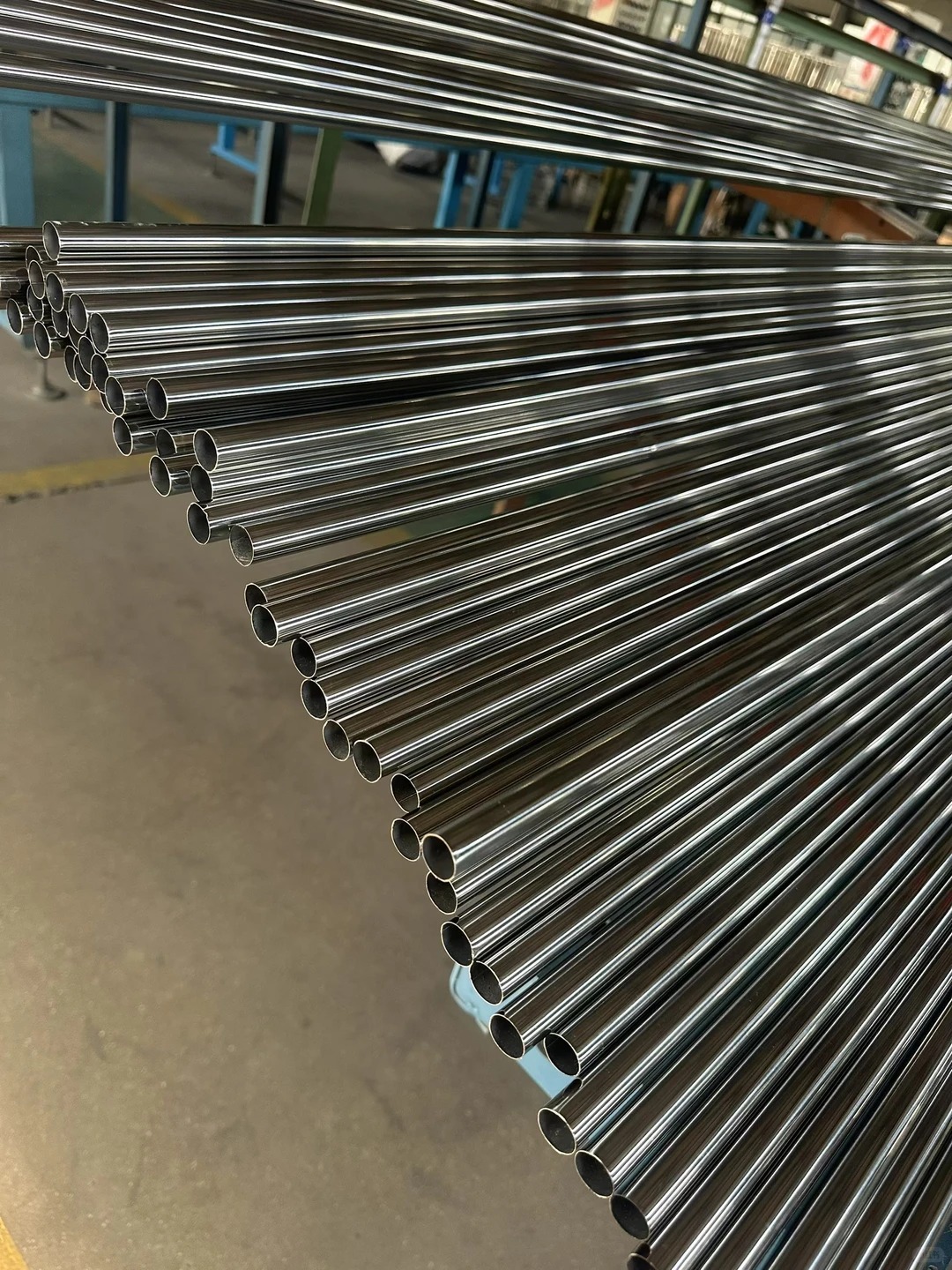
201 Stainless Steel Pipe / Tube — Manufacturer, Price, Specifications
Grade 201View Details →304 Stainless Steel Pipe / Tube — Manufacturer, Price, Specifications
Grade 304View Details →316L Stainless Steel Pipe / Tube — Manufacturer, Price, Specifications
Grade 316LView Details →321 Stainless Steel Pipe / Tube — Manufacturer, Price, Specifications
Grade 321View Details →Still Not Sure Which Material to Choose?
Send us your project specifications — our engineers will help you select the right steel grade at the best price.